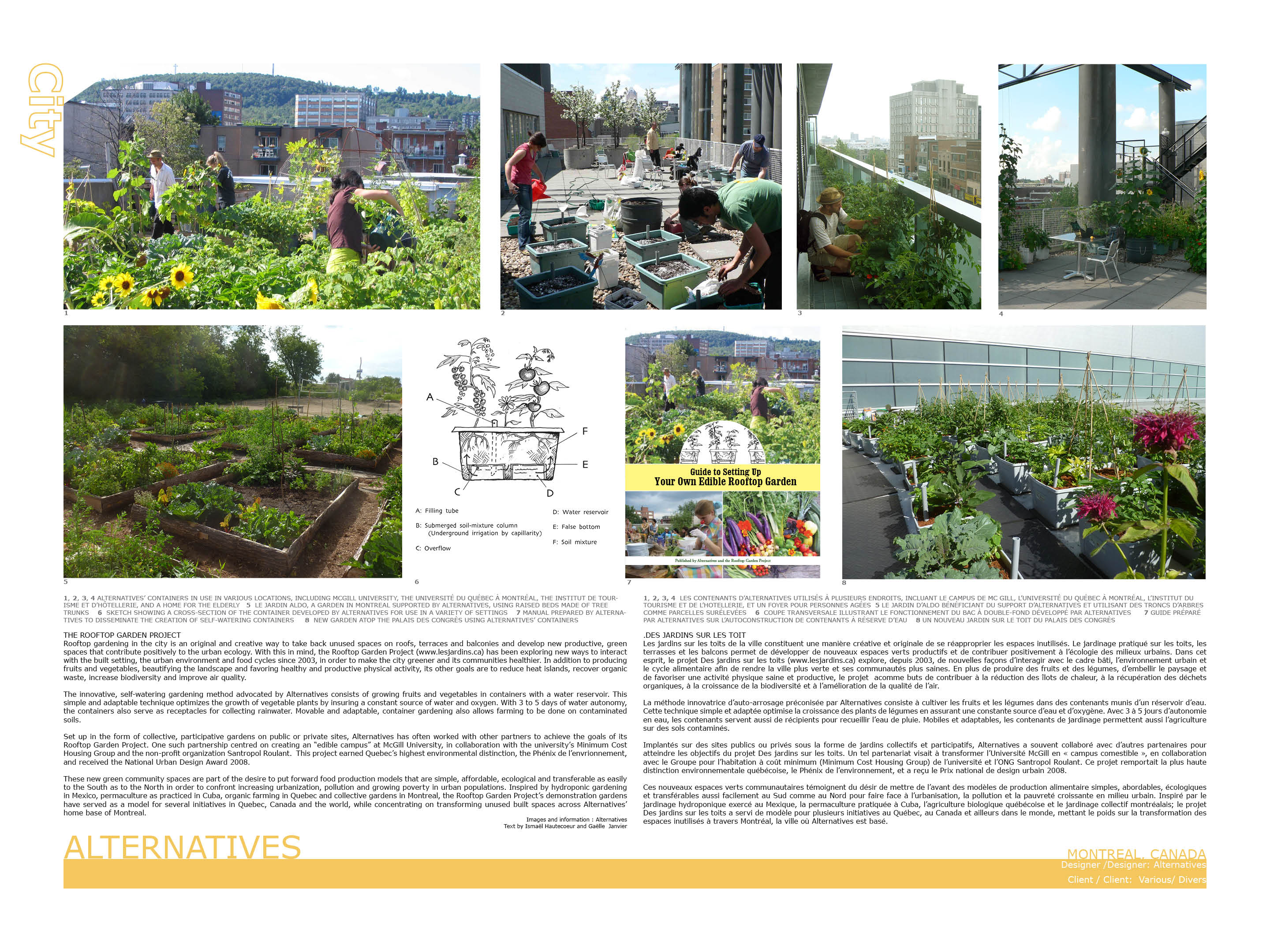
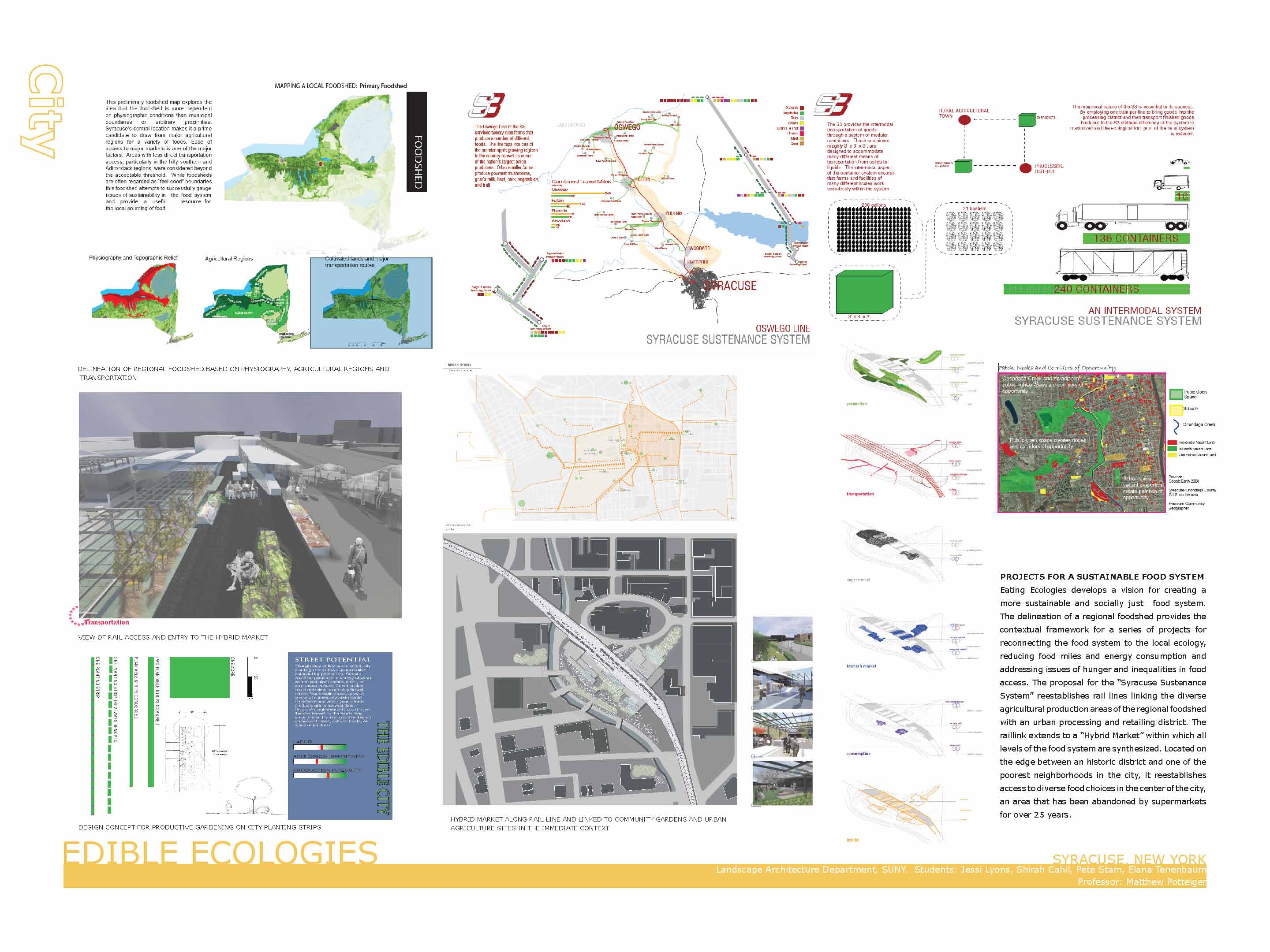
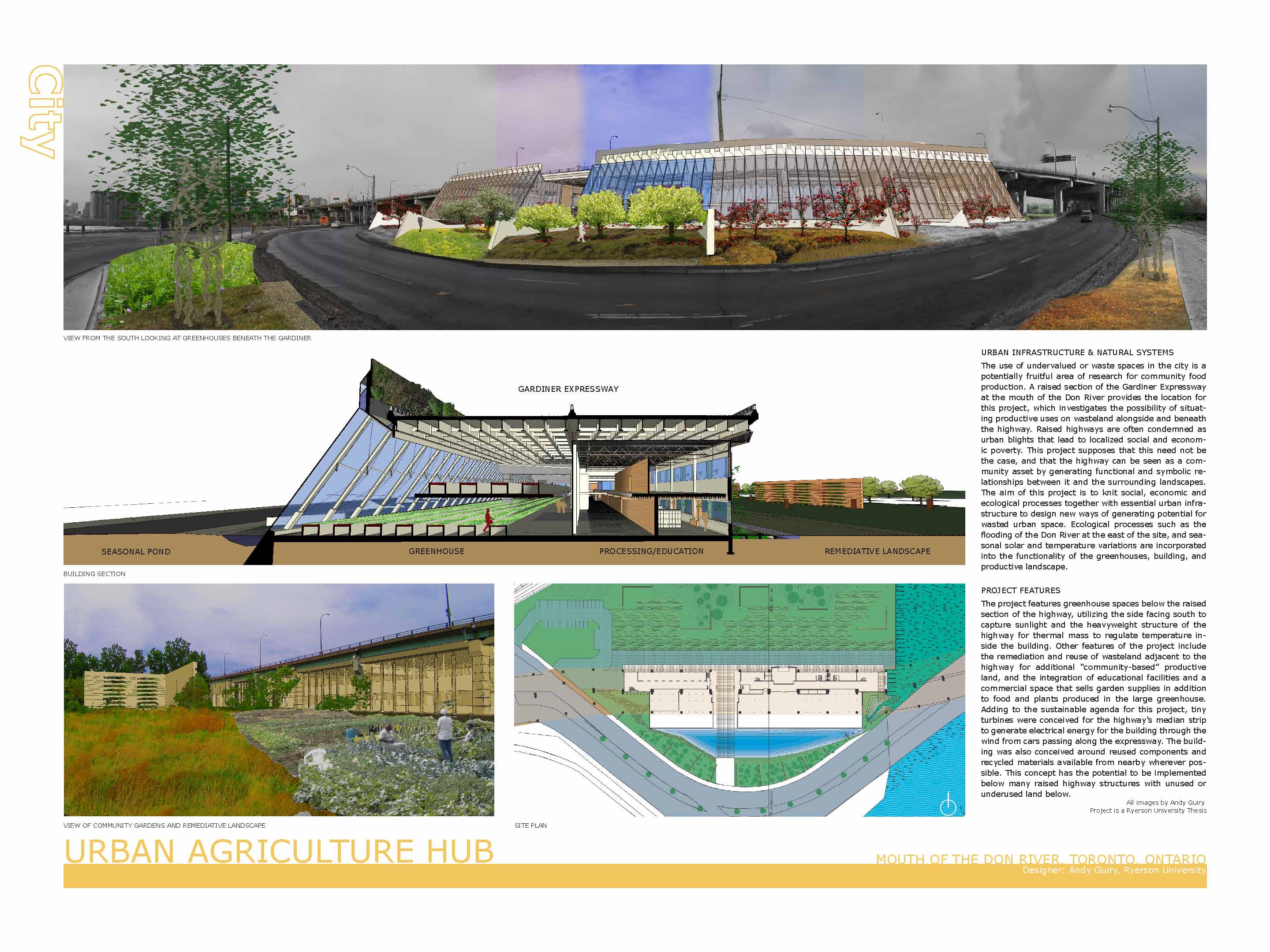
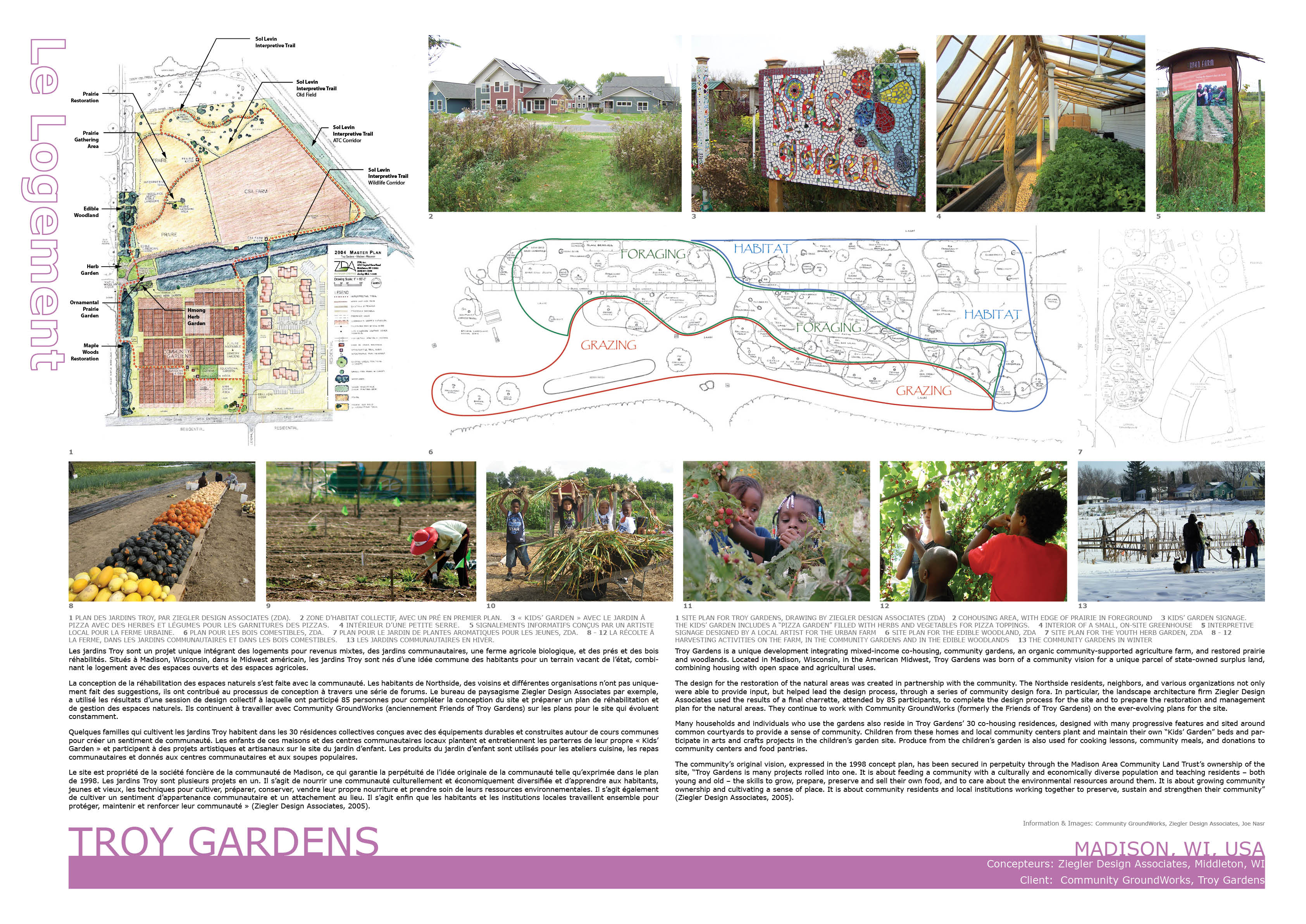
Before you bite into the next carrot from out of state, take a look at Carrot City, a preview of concepts that may someday come to an urban garden near you. A project based at Ryerson University, Carrot City seeks to add aesthetic appeal to the grungy task of growing food in urban areas. This site is the fruit of design students’ research on how to integrate agriculture with increasingly crowded cities.
Carrot City is international with a Canadian emphasis. The site’s designers published a book in 2011 and have also produced a YouTube video.
During the next century, our planet will continue to urbanize. In crowded neighborhoods, finding attractive ways to garden can be challenging. Carrot City’s case studies suggest tantalizing alternatives:
Urban gardens bring a smorgasbord of benefits to their communities. In addition to supporting local economies, improving public health, and reducing the environmental cost of food processing and transportation, gardening may even reduce crime.
Nina Mukherji is the Director of Programs at the Real Food Challenge in Boston and is a graduate of the Conservation Biology and Sustainable Development program at the University of Wisconsin-Madison.
Mukherji introduced herself and described the origin of her commitment to environmental and social justice.
…I grew up in New York City in the 1980s in a neighborhood that was between a lot of poverty and a lot of wealth. My father’s an immigrant from India. My grandparents had radical political views. I grew up with a strong sense of social consciousness and social justice.
I went to school in the Midwest and started to learn more about the resources that had been supporting me in the city. I started to see that corn was feeding cattle… I started to develop more of an awareness of ecology. It was my first time spending time in the country.
I got excited spending time [on] environmental issues, but my heart was in social issues. The world of environmentalism has been so far from the world of social justice organizing. It’s really hard to find the places where I think the things I really care about are happening and where my interest in social justice is there – where people care about dire poverty in this country and where food is going to come from in 50 years.
Q: What did you study in graduate school?
A: I studied Conservation Biology and Sustainable Development at the Nelson Institute. My advisor was in urban planning. I wrote my master’s thesis on urban agriculture policy. I looked at how zoning and comprehensive planning in cities affect the authority of how people want to grow food can do it. I focused on Boston, Chicago and Portland.
I was doing that thesis while working with the cities of Madison and Milwaukee. There was a zoning group looking at how the zoning in Madison could support more food in the city. I also went to some conversations about comprehensive planning in Milwaukee. It was cool because there was a blending of what I was doing professionally in a practical domain and what I was doing academically.
I found that cities are starting to reexamine their policies. There are many policies, both intentional and unintentional, that inhibit growing in cities. Because of the recession and there being more vacant land… people are seeing urban agriculture as a way to make cities better. I think that’s a trend across the board.
Urban vacant land in front of a construction zone. Source: stock.xchng.
I looked at how cities approach that process… whether it’s more of a grassroots or a top-down way. I’m volunteering for a working group that’s doing this in Boston… Boston has a very strong city government… As opposed to Madison, where the city delegated the task of making the zoning plan to a group of citizens who were interested in urban agriculture. In Boston, it’s driven by the city.
Q. How have your graduate school experiences informed your work since then?
A: I would say a lot of what I do in my professional work I learned through the organizing I did during school… That was an extracurricular activity. I’m not an organizer, but I do a lot of organizing. I train and supervise organizers on campuses.
I also work at the Real Food Challenge, where we work with students on getting more sustainable food on their campuses…I’m working on an assessment tool; I’m familiar with debates about certification and organic certification in general… and cage-free eggs. I use this knowledge as part of coming up with the assessment tool.
In a deeper way, the understanding I developed [about] the relationship between government and people and nonprofits and social movements, and what can be accomplished through the economy and what can be accomplished through policy, those questions about where responsibility should lie… Conversations in grad school have made me feel that the environmental movement has been co-opted by companies… [saying that] if we choose to buy fair trade, these abuses would not be happening. Through having discussions about that in grad school, I came to believe that to stop these really atrocious behaviors, individual choices are not going to be enough. Institutional change can shift the market.
My organization, the Real Food Challenge, we organize college students around the country to shift the purchasing at their schools from conventional industrial agriculture…. We’re having a mass procott. We’re creating institutional markets for responsible farmers, particularly mid-sized farmers. What’s exciting to me is that we’re engaging students who care about food to the point where they’re leaders in their communities….What we’re also doing is training thousands of people who are going to train thousands of more people. That’s what makes me hopeful.
There’s something about organizing that allows for a real level of integrity, because the people who are affected are the ones that are affecting the solution.
So far, we’ve shifted 50 million dollars in institutional food purchasing in the course of about three or four years. It’s through students advocating and organizing each other, working with the dining halls and learning about the food that they’re eating.
We have this Real Food Campus Commitment. We’re trying to get presidents to sign on. Our goal is to really ramp that up. We’re hoping it’s going to become the thing to do…. We want to see whole state systems making a decision to sign onto commitments like that.
The University of Vermont has just signed the Real Food Campus Commitment. The Intervale is an innovative urban agriculture incubator in Vermont. They’ve created a community-supported agriculture commitment in which they aggregate food from small- and medium-sized farms… They know for sure that they have a market. They know they will have someone to sell it to – like a university. That is helping them get the program off the ground. It’s boosting local agriculture in the area and improving the relationship between the university and the community.
The Real Food Challenge encourages colleges to buy locally grown vegetables. Source: stock.xchng.
Q: If you were going to give advice to current environmental studies students, what would you say?
A: I would say… think about the relationship between environmental issues and people. And both the impacts environmental problems have on people now, or will have, and the impact of those possible solutions on people. I think that’s the direction environmental studies is going, is more and more interdisciplinary. If we are actually going to solve environmental problems, we can’t do it justly without thinking about who is going to be affected and who’s in those conversations.
There was a story on the radio where a town that’s close to the ocean is subsiding and the ocean level is rising. Some people are having their houses flooded. The wealthier people are living higher up. The city is trying to think of a way to make wealthy people move within the city as opposed to recognizing the situation is extremely problematic for those who can’t afford to deal with it. I think the way many environmental advocates deal with problems tends to neglect the effect of the solutions on the community.
I am a big believer in public transportation. One of the biggest bus depots in the city of Boston is in Dorchester. The depot is uncovered. The fumes are giving people asthma. In Cambridge, they covered the bus depot so people won’t get sick from the fumes. The Harvard bus depot is well-ventilated. The city hasn’t prioritized the public health of [Dorchester].
However, we should take the opposite approach. Specific details make writing come alive for readers. If you want to wake people up, you should get concrete – as fiction writers say, show, don’t tell. (This is a useful approach for teachers too.) Also, getting down to specifics helps people make connections between actions and their results – a skill not everyone learns in school.
People often don’t graduate from high school with a clear sense of what they are eating. I’m a graduate of an urban high school. Although I had some great teachers, I don’t remember any of them talking with us about the snacks we were buying in the vending machines down the hall. We learned about cell division, but we never learned why environmental issues mattered in our neighborhoods or at our grocery stores.
In my twenties, I lived and worked in two “food deserts.” A food desert is a neighborhood where healthy food choices aren’t available to most people – either because grocery stores have left or because they are too expensive. (Replacing a more affordable grocery store in Jamaica Plain with a Whole Foods would be a step in that direction, by the way. Whole Foods may have the best organic mangoes around, but that doesn’t mean everyone can buy them.)
Locally grown food has not traditionally been a luxury. In many parts of the world, it still isn’t. Community gardening is one way to rebuild local access to vegetables and fruit.
Communities that are interested in gardening should also have conversations about food preservation. Often, if you want year-round access to locally-grown vegetables, you have to know how to preserve them and have the equipment to do it. In Boston, you can’t pick tomatoes outdoors in winter. We just had a 17-inch snowfall last week.
Many people take a moral stance about eating health food, but this stance ignores the reality that convenience and access often determine our choices. Cooking takes time and effort, even if one plans ahead and cooks in bulk.


 Kat Friedrich